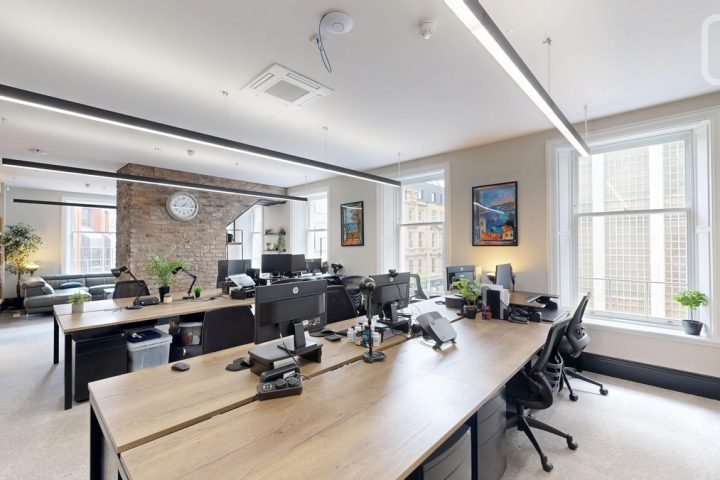
Renting your first office is a big step. It signals that your business is growing and that you are ready to put down proper roots. But if you have never navigated commercial property before, the process can feel more complicated than it needs to be.
This guide covers everything you need to know, from working out how much space you need to understanding your lease and negotiating the best deal.
Key takeaways
- Allow 80 to 100 sq ft per person as a starting point for space planning, and factor in room to grow.
- There are three main office types: serviced, managed, and leased. Each carries different costs, flexibility, and commitment levels.
- Landlords will carry out a covenant check before agreeing a lease. If your business has a limited trading history, expect to provide a larger deposit or personal guarantee.
- Always instruct a solicitor with commercial property experience to review your lease before signing.
- The asking rent is rarely fixed. Rent-free periods and other incentives are negotiable, particularly on longer leases.
Step 1: Work out what you actually need
Before you start browsing listings, get clear on your requirements. The more precise you are upfront, the smoother the search will be.
How much space?
A common starting point is around 80 to 100 sq ft per person for a standard open-plan layout. A team of five would typically be looking at 400 to 500 sq ft. If you want private offices, a dedicated meeting room, or a breakout area, build extra space in on top of that.
It is also worth thinking about where you will be in two or three years time. Taking a space that fits your team today but leaves no room for growth can mean an expensive move sooner than you would like.
Location
Manchester has a range of distinct office submarkets, each with its own feel and price point. The city centre, including Spinningfields, the Northern Quarter, and First Street, tends to command the highest rents. If budget is a consideration, areas like Salford Quays, Ancoats, or Altrincham offer strong value without a significant compromise on quality or connectivity.
Think about how your team commutes, whether clients will visit, and what your address says about your business.
Budget
Costs vary considerably depending on the type of office you choose. For a conventional leased office, headline rents for new build Grade A space in Manchester city centre are currently around £46 per sq ft per year. Refurbished Grade A options sit more in the £30 to £40 per sq ft bracket, with Grade B options available from around £20 per sq ft. Serviced offices are priced on a per-person basis, typically ranging from £250 to £700 per person per month on an all-inclusive basis.
Do not look at headline rent in isolation. Business rates, service charge, utility bills, and fit-out costs all need to be factored in. A good commercial agent can walk you through a full occupancy cost breakdown before you commit to anything.
Step 2: Understand your office type options
There are three main ways to rent office space in Manchester. The right choice depends on where you are as a business and how much certainty you have about your future needs. For a full side-by-side breakdown, see our guide to serviced vs managed vs leased offices in Manchester.
| Type | Monthly cost | Setup time | Min. term | Best for |
|---|---|---|---|---|
| Serviced | £250 to £600+ per person | 24 to 48 hours | 1 to 3 months | Start-ups, fast growth |
| Managed | £30 to £75 per sq ft | 2 to 4 weeks | 12 months+ | Scaling teams |
| Leased | £20 to £46 per sq ft | 6 to 12 weeks | 3 years+ | Established businesses |
Serviced offices
A serviced office is a fully furnished, all-inclusive workspace that is ready for immediate use. Furniture, utilities, internet, and access to shared facilities are all covered in a single monthly fee. Contracts are short and flexible, often starting from just one month.
The trade-off is cost. Serviced offices carry a premium over conventional space. That said, the minimal upfront investment and the ability to scale up or down quickly make them an excellent starting point for a growing business.
Managed offices
A managed office gives you a customisable space where the fit-out cost is funded by the landlord and spread across the lease term. Facilities management, utilities, and internet are typically bundled into a single bill, but you get more space and control than a serviced office provides.
Managed offices are a strong middle-ground option for businesses that want a branded, private environment without the full commitment and upfront investment of a conventional lease.
Leased offices
A leased office is the traditional route. You take a lease directly from the landlord, take on full responsibility for fit-out, rates, service charge, and day-to-day management, and get complete control over the space. Leases typically run for a minimum of three years.
This option carries the highest upfront cost and commitment but offers the best long-term value per sq ft for a business with stable, predictable space requirements.
Step 3: Start your search
Once you know what you are looking for, you can start actively searching. Online platforms give you a sense of availability and asking rents, but working with a specialist commercial agent gives you access to off-market stock and genuine market knowledge.
Try to view at least three or four spaces before making any decisions. It is much easier to compare options once you have been inside them. Pay attention to practical details that do not always come through in listings: natural light, the condition of shared areas, broadband infrastructure, car parking, and proximity to public transport.
Step 4: Understand your lease
A commercial lease is a legally binding document and can run to considerable length and complexity. This is not something to skim over.
Key terms to understand
Lease length and break clauses. Most conventional leases run for a minimum of three to five years. A break clause gives you the option to exit early at a set point, usually the midpoint of the term. Make sure to look at what conditions you have to action your break under as some come with requirements that are difficult to satisfy in practice.
Rent reviews. Most leases include rent review provisions every three to five years. Pay attention to the review mechanism. Upward-only reviews mean your rent can only increase at review, never decrease.
Repairing covenants. The lease will define who is responsible for repairs and maintenance. This typically falls under FRI (Full Repairing and Insuring), EFRI (Effective Full Repairing and Insuring), or IRI (Internal Repairing and Insuring) terms, each carrying different levels of tenant liability. For a full explanation, read our guide to FRI, EFRI and IRI repairing covenants.
Service charge. In multi-let buildings, tenants contribute to the cost of shared areas via a service charge.
Dilapidations. At lease expiry, you will typically need to return the space to its original condition. A Schedule of Condition agreed at the outset legally limits your liability to pre-existing defects. Always insist on one.
Deposits and covenant checks
Before agreeing a lease, landlords will carry out a covenant check to assess whether your business can meet its financial obligations over the lease term. This typically involves reviewing your company accounts, checking net profit against the annual rent, and sometimes requesting a bank reference.
If your business is new or has a limited trading history, this is where first-time tenants can get caught out. A landlord who is not confident in your covenant strength will often ask for a larger deposit to offset their risk. Where a standard deposit might be one to two months’ rent, first-time tenants with a short trading history should budget for three months’ rent or more upfront. In some cases, a landlord may ask for a personal guarantee instead of, or in addition to, a larger deposit, meaning the director becomes personally liable if the company defaults.
None of this should put you off. It is simply worth knowing before you get to the negotiation stage, so you are not surprised by the cash requirement. If your accounts are limited, be upfront with your agent early so they can manage landlord expectations from the outset.
Step 5: Negotiate the terms
Many first-time tenants assume the asking rent is fixed. It is not. There is almost always room to negotiate, particularly on rent-free periods, the headline rent, and lease length.
In a well-supplied market, or where a landlord has been carrying a void for some time, you are in a stronger position than you might think. Rent-free periods are common on longer leases. Landlord contributions towards fit-out costs are not unusual either.
A commercial agent who knows the Manchester market will have visibility of what comparable deals have been done and where there is genuine room to move. That intelligence is hard to replicate without one.
What happens after terms are agreed?
Once heads of terms are agreed, the deal moves to formal legal documentation. Solicitors for both sides will negotiate and exchange the lease, carry out searches, and finalise the detail. This process typically takes four to twelve weeks, depending on complexity.
You will need to provide references, usually trading accounts and a bank reference, to satisfy the landlord’s covenant checks. Once contracts are exchanged and a completion date confirmed, you can start planning your fit-out and move-in.
Ready to find your first Manchester office?
Renting your first office does not have to be an overwhelming process. With the right advice and a clear idea of what you need, it is very manageable.
At Canning O’Neill, we work with businesses of all sizes across Greater Manchester, from start-ups taking their first space to established companies relocating or upsizing. If you would like to talk through your requirements, get in touch with our team today.
Office space in Greater Manchester
Manchester City Centre · Salford Quays · Altrincham · Sale · Old Trafford · Wilmslow · Manchester Airport
FAQ
How much does it cost to rent an office in Manchester?
It depends on the office type. Conventional leased space in Manchester city centre ranges from around £20 per sq ft for Grade B up to £46 per sq ft for new build Grade A. Serviced offices are priced per person, typically £250 to £600 per month on an all-inclusive basis. Managed offices sit in between, usually £30 to £75 per sq ft.
How much office space do I need per person?
A common starting point is 80 to 100 sq ft per person for an open-plan layout. If you require meeting rooms, private offices, or breakout areas, you will need to add extra space on top. It is also worth factoring in anticipated headcount growth over the term of your lease.
What is a covenant check and will my business pass one?
A covenant check is how a landlord assesses whether your business is financially strong enough to meet its rent obligations over the lease term. They will typically look at your company accounts and check that your net profit is sufficient relative to the annual rent. If your business is new or has limited accounts, you are unlikely to be turned away, but the landlord may ask for a larger deposit or a personal guarantee to offset the additional risk.
How much deposit will I need to pay for a Manchester office?
It varies depending on the landlord and your covenant strength. Businesses with a solid trading history typically pay one to two months’ rent as a deposit. First-time tenants or newer businesses should budget for three months or more. In some cases, a landlord will ask for a personal guarantee from a director rather than, or alongside, a cash deposit.
What is the difference between a serviced, managed, and leased office?
A serviced office is fully furnished and all-inclusive, available on short flexible contracts from around one month. A managed office gives you a customisable private space with facilities managed on your behalf, usually on a 12-month minimum term. A leased office is a conventional arrangement where you take full control and responsibility for the space, typically on a three-year minimum lease. For a detailed comparison, see our guide to serviced vs managed vs leased offices.
Can I negotiate the rent on a commercial office lease?
Yes. The asking rent on commercial office space is often negotiable. Rent-free periods, landlord fit-out contributions, and adjustments to the headline rent are all common outcomes of a well-run negotiation, particularly on longer leases or where the landlord has been carrying a void.
What is a Schedule of Condition and do I need one?
A Schedule of Condition is a document that records the state of the property at the start of your lease. It limits your dilapidations liability at lease expiry to the condition the space was in when you took it on, preventing you from being required to repair pre-existing defects. It is strongly advisable for any conventional lease.
Do I need a solicitor to rent an office?
For a conventional commercial lease, yes. A commercial lease is a legally binding document that can carry significant financial obligations. The cost of proper legal advice is minimal relative to the liability you are taking on.